Starting a mobile detailing operation looks simple from the curb, a clean van, a pressure washer, a stack of microfiber. The reality is a moving shop with water, power, chemicals, and delicate surfaces packed into a few square feet. Get it right and you move efficiently, show up ready for anything, and avoid the costly mistakes that chew up profit. Get it wrong and you waste time hunting for bottles, tripping on hoses, and chasing battery faults while a customer watches their schedule slip.
This guide breaks down what actually works: tools that earn their spot, van layouts that flow, and power systems that keep everything humming. It also touches the practical edges, like transitioning from car detailing to RV detailing, or preparing for ceramic coating on a windy job site. The advice comes from real stumbles, trial runs, and long days cleaning grit out of door cards.
The core kit that pays its rent
The best kit is the one you will use daily, not the shiny piece you admire once a month. Think in use cases, exterior wash, decon, interior reset, correction, protection. That helps you avoid overbuying and keeps each drawer or bin focused.
A reliable electric pressure washer in the 1.4 to 2.0 GPM range with 1,500 to 2,000 PSI is the workhorse. Gas has grunt, but the noise, fumes, and maintenance bite you, especially near condos or marinas. A compact electric unit paired with a 50 to 100 foot hose on a reel covers most driveways and tight streets. Keep quick connects on everything and carry a spare gun, the five dollar O-ring that fails will do it right in front of a picky client.
A good vacuum, not a toy. Look for 125 to 150 CFM and around 70 inches of water lift. A small cyclone separator adds time back to your day by keeping the filter from clogging with sand. For interiors, a dual-motor unit is nice, but watch the amp draw if you power it from batteries. When you pair the vac with a cordless blower, crumb evacuation around pedals and rails gets faster and safer.
For chemicals, standardize. A pH-neutral shampoo, an alkaline APC around pH 10 to 11 diluted properly, an iron remover, a tar remover, a clay lube, and a glass cleaner cover 95 percent of auto detailing. Wheel cleaner can be non-acid with iron-reactive properties for most cases. For boat ceramic coating and gelcoat prep at the marina, bump your decon focus to heavier oxidation removers and solvent-safe degreasers, and confirm everything is marine safe and allowed on the dock.
Compounds and polishes should match your machines and pad system. A dedicated medium-cut compound and a finishing polish from the same brand reduce surprises. Microfibers count more than marketing: 300 to 400 GSM for interiors, 500 to 600 GSM for rinseless and drying, and short-pile applicators for trim and tires. Track them by color or edge style so glass towels never touch paint. Tape a laminated towel code near the rear doors so a helper never guesses.
Polishers are the fulcrum for paint correction. A 15 mm long-throw dual action with a 5 inch backing plate is the daily driver. Add a 3 inch machine for pillars and bumpers, and, if you chase deep defects or work on rock-hard German clear, carry a small forced-rotation unit. For RV detailing, especially on oxidized fiberglass, a rotary with a wool pad and a controlled hand is still the fastest path to clarity. The trick is heat control and edge awareness. You are only one slip from a crisp line that should not be there.
Coatings need their own space and rhythm. Keep ceramic coating bottles upright, cool, and dated. Once opened, most last months, not years. For mobile ceramic coating on cars or boats, bring a canopy if conditions allow, a panel prep with the proper solvent balance, and more lighting than you think you need. A headlamp plus a 5,000 Kelvin LED panel reveals high spots before they cure. Many of the failure stories in ceramic applications boil down to missed wipe timing and contaminated microfiber, not product choice.
How we learned to pack a van for flow
Every van has a personality. A RAM ProMaster City, Ford Transit Connect, or Metris has enough room for a single tech to move quickly without excess weight. A long-wheelbase Transit or Sprinter invites a full water setup, batteries, and a two-person team. The first layout you try will not be the last.
At Kleentech Detailing LLC, our first serious layout in a mid-size van put the water tank over the rear axle, the pressure washer on a slide-out to the right door, reels stacked left, and chemicals hung on a French-cleat style board forward. It worked, until it did not. We learned that mounting both hose reels on the same side sounds logical but creates cord spaghetti when the driveway forces you to approach from the passenger side. Splitting reels, air and water left, vacuum and extension cords right, cut our setup time in half on awkward sites. It also reduced the dance around the back bumper.
Weight distribution is not an academic topic. A 65 gallon tank at 8.34 pounds per gallon adds more ceramic coating than 540 pounds. Keep that mass centered and low. Use a proper bulkhead and through-bolted brackets with steel plates, not just self-tappers into thin sheet. Add anti-slip matting under the tank and a vented cap, then plumb a shutoff at the tank outlet to service filters without dumping 20 gallons on the street. If you only do maintenance washes and light paint protection film or vinyl wrapping installs at a shop, drop to 30 to 40 gallons and save the weight and braking distance.
The floor needs to be washable and durable. We like coin rubber or marine-grade vinyl with sealed seams. Small lips at the thresholds help contain the inevitable spill. Plan for drainage, but never drill through structure without checking what lives below. Brackets should align with factory reinforcement, and you should add rivnuts for accessories rather than sheet metal screws that loosen.
Chemical storage belongs inside sealed bins with gaskets, not open caddies. Heat cycles and van motion will loosen caps. If you ever opened a door to a sweet solvent cloud, you know why. Label bins by category and dilution, and stash a dozen empty 32 ounce bottles with sprayers, all the same model. Uniformity saves minutes. It also lets you cap and toss a leaking head without mismatched threads.
Lighting and sight lines inside the van matter more than you think. Install LED bars on the ceiling and at least one low strip near the floor. Losing a black pad ring or Torx bit in a dim van costs more time than the price of lights. Mount the polishers with padded hooks and retainers to stop them from banging around. Hoses should live on reels, and reels should have a fairlead, so you do not scuff the door trim every day.
Power, the quiet spine of mobile efficiency
You can run a mobile rig three ways: shore power at the client’s outlet, a generator, or a battery inverter system. Most operations mix all three.
Shore power is ideal when available and within 50 to 100 feet. Use a 12 gauge, 100 foot cord with a GFCI and a three-light tester. Document the amp draw of your vacuum, extractor, and polisher so you do not trip a 15 amp breaker. A small panel with a voltmeter at the van entry tells you when the line droops before you stall a motor mid-pass.
Generators bring freedom and noise. Inverter generators in the 2,000 to 3,000 watt range cover a pressure washer, vacuum, and polishers if you stage loads. Keep spare oil and plugs, and track hours for maintenance. The downside is customer sensitivity, HOA rules, and fumes. For boat marinas and tight neighborhoods, we often park farther away and run longer hoses to keep the generator out of earshot, or we switch to batteries for short runs.
Battery power, when built correctly, feels like magic. A 12 V or 24 V lithium iron phosphate bank paired with a 2,000 to 3,000 watt pure sine inverter will run a vacuum, polishers, lights, and small heaters or fans. Pressure washers can be electric, but starting surges matter. Look for soft-start models or add a start capacitor and size the inverter accordingly. A realistic mobile setup uses 200 to 400 Ah of LiFePO4, a DC-DC charger from the alternator, and shore power charging at night. Roof solar helps top off between jobs, but it will not replace your charging needs if you do two full interior and exterior packages back to back.
We built one Kleentech Detailing LLC van around a 300 Ah lithium bank, a 3,000 watt inverter, and a 60 amp DC-DC charger. That rig powered a 1.8 GPM electric washer, vacuum, steamer, and all lights for two average jobs without noise. The steamer was the limit, it spikes and stays hungry. For days with paint correction and ceramic coating, where the vacuum cycles less and polishers run steady, battery power shines because of the lower draw and the quiet focus it brings to the work.
Do not forget grounding and safety. Bond your inverter chassis to the van body at a known grounding point. Protect all runs with fuses or breakers rated for the cable gauge and distance. Use marine-grade lugs and heat shrink. Secure cables away from sharp edges and heat. Keep an ABC fire extinguisher near the rear doors and a second one up front. A simple laminated one-line diagram taped inside a cabinet helps when troubleshooting under pressure.
Water and filtration choices that match the jobs
Water cuts or cures your downstream headaches. Hard water leaves spots that haunt you when you work in the sun or coat a surface. Carrying your own water with a measured TDS reduces surprises. Many mobile detailers run a deionized system for the final rinse, feed water may remain tap if you work quickly.
If you do ceramic coating frequently, a two-stage carbon and sediment filter before the tank extends your pump life and keeps orifices clean. An inline RO/DI system is heavy and slow for most vans. A better compromise is to make spot-free water at your shop, fill the tank with low TDS water, then top off with DI resin at the van only when traveling far or running long days. Monitor TDS with a handheld meter and jot numbers on the job sheet. If you detail boats or work at marinas, salt spray and minerals add complexity. Rinse liberally, use blowers, and accept that DI resin will deplete faster near salt air.
For RV detailing, especially on ladder-heavy days, water management doubles as safety. Run hoses along one side, tape or cone if the jobsite has foot traffic, and keep the work lane dry. Water spots on oxidized gelcoat bake quickly, so break the vehicle into sections and manage shade. A foam cannon helps dwell time on big panels without waste, but make sure the foam is not your crutch, agitation still matters.
Organizing for different service lines: cars, RVs, boats, and film
Mobile detailing covers more than washing a sedan in a driveway. The gear shifts a bit when you step into paint protection film, window tinting, or vinyl wrapping on the road. Some work fits mobile perfectly, some should steer back to a controlled shop.
Paint correction on automotive clear is a natural mobile service so long as your lighting travels with you and you can control dust. A pair of tripod LEDs at 5,000 to 6,000 Kelvin and a headlamp make a difference. Keep a lighted inspection mirror for rockers and under-door lips. Correction on soft Japanese paint and hard German clear requires different pads and pressure. Test spot every car, write your winning combo on a whiteboard or in a notebook, and save it. After a year, that book will earn its keep when you see the same color and maker again.
Ceramic coating is doable outside, but not anywhere, anytime. Watch humidity, temperature, and wind. Misty evenings cause smearing, high heat flashes too fast, and gusts carry dust onto panels. A pop-up canopy with sidewalls helps, but you need weight bags and a plan for gusts. Use fresh microfiber in high count, short nap, and inspect under multiple angles. Many issues blamed on products come down to environment and wipe timing across the panel.
Paint protection film asks for clean air, moderate temperature, and a dust-free surface. Mobile installs on hoods and fenders can work under a canopy with a calm day and corner setup, but full front or complex bumpers are risky on the curb. Keep a pump sprayer for slip solution, a cleaner slip formula for small edges, and a heat gun with a temperature guard. Carry extra blades and a small cutting mat to avoid scoring plastic or paint. If the wind picks up and debris floats, reschedule rather than fight. Clients respect honesty when you explain the risk to the finish.
Window tinting and vinyl wrapping want stable environments. For tint, dust control makes the difference between a smooth edge and a trapped hair that you have to explain forever. Mobile tint is possible inside a garage with closed doors and a filtered fan. Otherwise, limit to smaller glass panes with good shelter. Vinyl wrapping partials like roof or mirror caps can be mobile, full wraps should stay in a shop with tables, lighting, and room to unroll properly.
Boat ceramic coating is its own animal. Gelcoat drinks product differently than automotive clear, and oxidation prep can demand a rotary with wool and a cutting compound. Your footing changes too, marinas mean narrow docks and strict rules on runoff. Confirm where you can stage, protect against splashes, and use a life jacket when you are alone on a side deck. Wipe patterns matter on curved hulls, chase edges and waterlines with patience, and avoid working above your head for long spells without a plan. UV on the water feels stronger. Wear sleeves and hydrate.
A day in the field: where time leaks and where it is saved
Early on, our team at Kleentech Detailing LLC learned that the first 15 minutes decide the hour. If the hose reel binds, the vac bag is full, or the polisher cord gets trapped under the tire, your tempo goes off beat. We built a short preflight check the night before: top off water, empty vac, clean pads, charge batteries, stage clean towels in sealed bins, and check the weather for wind, heat, and rain chances. That five minute loop saves 30 minutes of fumbling.
On site, park with your rear doors facing the longest side of the vehicle if possible, avoid uphill parking that makes the tank slosh toward the doors, and leave curb clearance for hoses. Identify where you will stage dirty towels, used applicators, and spent masking. Contain it from minute one so you do not clean the same mess twice.
Work inside out or outside in depending on conditions. On a blazing day, clean and protect interiors first while the panels are cool, then wash and decon outside in shade if you can. In cold weather, spin the order, do the exterior first so the interior warms up with doors closed later. Always blow out seams and badges after your final rinse to avoid drip lines during drying. The small air cannon you debated buying pays off every time you coat a vehicle and hunt for last drops.
The last 10 percent of a job defines the memory of the service. Inspect glass edges, lower door pockets, exhaust tips, and the area under the hatch latch. Leave a crisp scent, not a heavy perfume. If you applied ceramic coating, educate the client on first-week care, but keep it simple: no harsh washes, avoid sprinklers, gentle rinses only. Document the products used and the date somewhere private in your CRM. You will thank yourself at the maintenance visit.
Safety, ergonomics, and the long run
Mobile detailing is physical. Knees, shoulders, and back bear the brunt if you do not build habits. Simple upgrades, like a rolling stool, knee pads, and a small platform for roof work, reduce fatigue and injury. Choose lighter polishers when you can, coil weights from cords add strain, so cordless machines make sense for some tasks even if they eat batteries faster.
Chemicals deserve respect. Wear nitrile gloves and eye protection during decon and coating work. Keep SDS sheets in a folder inside the van. Ventilate during APC work in cabins. Use a respirator when spraying anything atomized, even glass cleaners can irritate with hours of exposure. Store acids and bases apart and never in the same spill tray. Double-check local rules on gray water disposal, especially if you operate near storm drains or marinas.
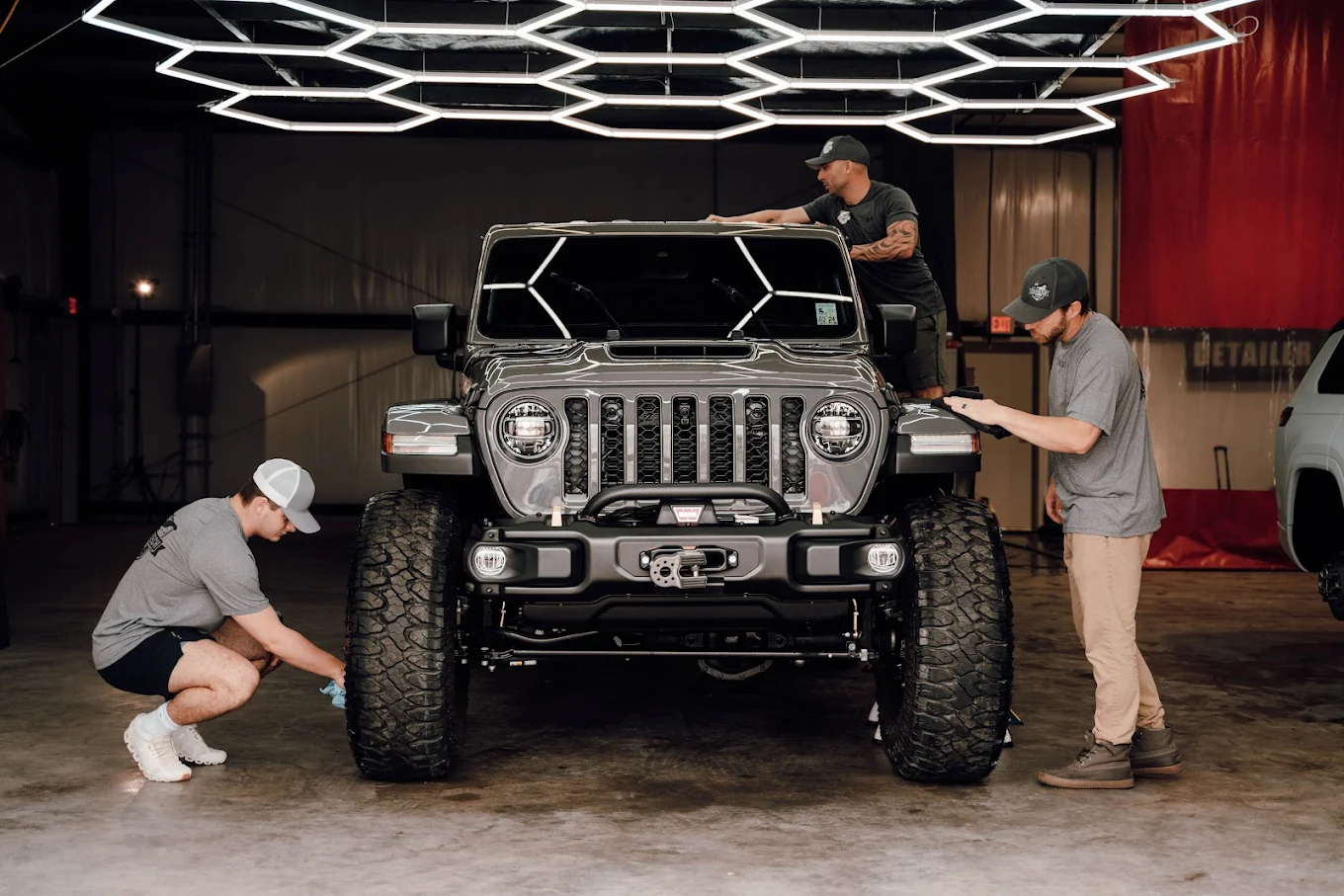
Electrical safety can fade from mind when the day gets hot. GFCIs, intact cords without nicks, dry hands on plugs, and proper cord routing keep your operation out of trouble. Train helpers to unplug before moving a tool and to loop cords at the van, not at their feet. A quick safety huddle before starting a two-person job keeps everyone on the same choreography.
Pricing your time by designing your kit
Tools and layout affect your effective hourly rate as much as your sticker price. A 90 second hose deploy beats a five minute tangle. A battery rig saves a conversation with a property manager about outlets. Quick pad cleaning on a drill-backed brush keeps the correction line moving without a stop at the sink. All of these choices accumulate into half an hour saved per job, which, over a week, turns into one more appointment or a little breathing room before dusk.
We saw this firsthand at Kleentech Detailing LLC when we switched from loose bottles in milk crates to a two-tier, quick-release rack with metered dilution sprayers. The move cost a few hundred dollars and a Saturday of fitting. Over the next month, we cut our search time for chemicals nearly to zero and reduced spill losses. The net was measurable. Our two-person crew finished most maintenance details 20 to 30 minutes faster without shortcuts, and the work area looked more professional to the client, which matters when you park in a driveway with neighbors watching.
Weather, shade, and the dance with the sun
You will fight the sun, wind, and rain more than you think. Shade is a tool, not a luxury. Scout shade angles when you arrive, start on the panels that will be in sun later, and save the already-shaded side for heavy work like paint correction or coating. If wind picks up, adjust. Foam and rinse turn into overspray risk on a breezy day near other vehicles.
Cold changes dwell times and flash behavior. Coatings can haze differently, polishes may dust less but cut slower. Warm your pads by working them on glass for a moment, not with a heat gun that can melt backing plates. In heat, shorten panel sizes, use more lubricants, and keep towels inside the van until the moment you use them.
Rain does not always kill a job. Interiors, engine bays, and some correction tasks can proceed inside a garage with doors cracked. Keep a plastic floor runner and wipe your shoes to avoid tracking grime. If you live in a place with changeable weather, carry a compact canopy and sandbags in the van year round. We have salvaged many appointments with a 10 by 10 canopy that goes up in two minutes, even if all it does is shield the windshield for tint or provide a dry patch for pad prep.
Growing into advanced services without losing mobility
As you add paint protection film, window tinting, or vinyl wrapping, you might feel pressure to turn the van into a rolling wrap bay. Resist the urge to cram everything. Decide what travels and what stays in the shop. For PPF, carry a pre-cut kit or a plotter only if you have the space and power. Otherwise, pre-cut at the shop, label meticulously, and transport flat in sleeves. For tint, a clean board, slip solution, and a small tool caddy fit in the van, but full film rolls and a heat box belong in a controlled space.
Mobile ceramic coating integrates naturally with standard detailing, just refine your scheduling and conditions. Limit coating appointments to mornings or sheltered afternoons, and buffer your schedule to allow for extra wipe time if the environment demands it. Communicate clearly what you can promise at the curb and what requires shop conditions, like multilayer systems or complex PPF integration.
RV detailing is a lucrative lane if you prepare for ladders, reach, and water. Carry stabilizers for ladders, a collapsible scaffold if you have room, and extra hoses. Expect to move your setup two or three times around a large coach. Plan your sections, avoid chasing your tail, and manage runoff respectfully. If you offer ceramic to RV clients, explain that gelcoat behaves differently and often requires more prep to hold gloss, and that coating large vertical surfaces in wind is a team task.
Two compact checklists to keep the gears meshed
- Night-before checks: batteries charged, towels packed in sealed bins, pads clean and sorted, vac emptied, water topped off, chemicals refilled and labeled, weather reviewed with a canopy plan. On-site flow: park for hose access, stage cords with GFCI, identify shade strategy, set dirty towel bin and waste area, confirm client priorities, work panel order based on sun and wind.
When to say no, and how that keeps your brand safe
Not every job is a fit for a mobile setup. Full front PPF on a windy street, full vinyl wraps in pollen season, or ceramic coating during an oncoming dust storm will hurt your reputation. It is better to decline or redirect to a shop day than to deliver a result you would not want on your own car. The long game favors restraint.
At Kleentech Detailing LLC we learned to frame these decisions as craft, not convenience. If a client asks for boat ceramic coating on an open dock with whitecaps and grit in the air, we walk the site with them, show the risks, and propose an early morning window with calmer conditions or a slip closer to shelter. That conversation has built more trust than trying to force a bad setup to work.
Final thoughts from the van floor
Success in mobile detailing lives in the thousand small decisions that shape your daily rhythm. Choose tools that solve clear problems. Layout your van so that your hands find what they need without thought. Build a power system sized to your real loads, not just a wish list. Prepare water that respects the finish. Work with the weather and know when to pivot. Keep safety at the front of your mind so you can keep doing the work for years.
Car detailing, auto detailing, paint correction, ceramic coating, paint protection film, RV detailing, vinyl wrapping, and window tinting can all live under one mobile roof if you design for them, schedule them wisely, and respect the edges where mobile reaches its limits. The payoff is a cleaner flow, steadier results, and a brand that clients remember for craft and calm competence, not for frantic improvisation.
Treat your van as a living shop. Tweak one thing a week. Write down what breaks and what saves time. If you do that, the setup will start to feel invisible, the work will take center stage, and your clients, whether at a quiet cul-de-sac or a busy marina, will see the difference in the finish you leave behind.